
AANI-FB-0174-1 FPC Antenna: Measured Band Performance
Measured S11, realized gain, and efficiency reveal distinct performance regions across the device’s cellular bands. This report summarizes performance highlights, test methodologies, and integration guidance for field validation.
Product Overview & Band Mapping
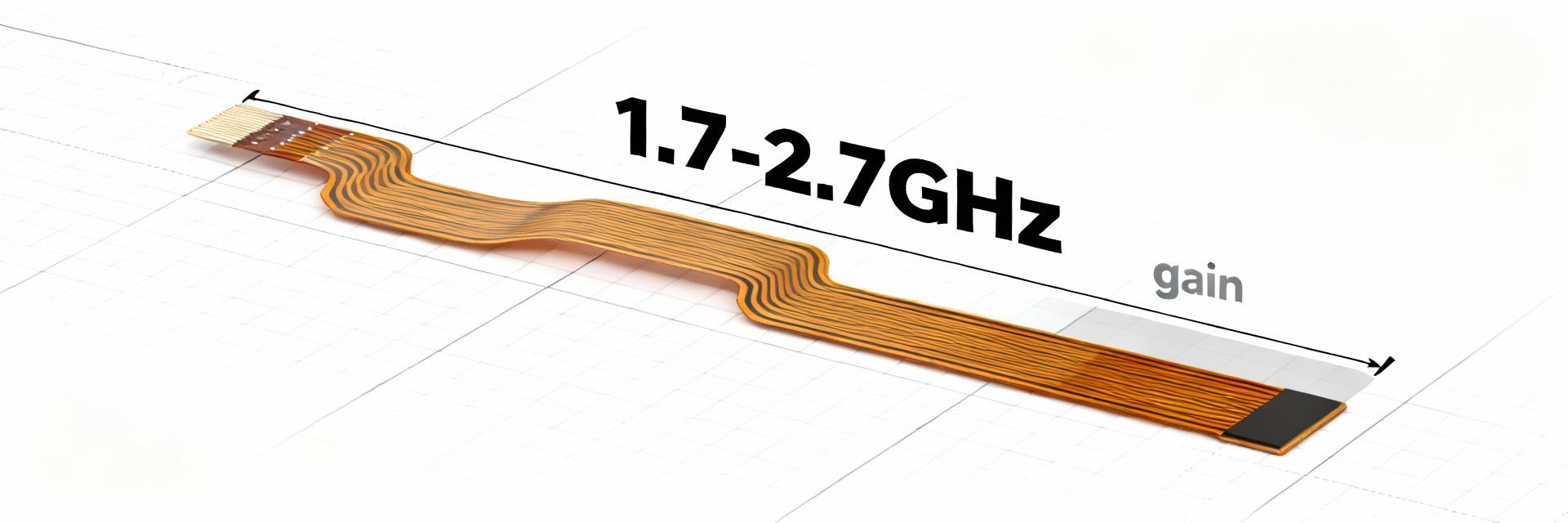
Technical Specifications
The AANI-FB-0174-1 is a precision-engineered flexible printed circuit (FPC) antenna optimized for cellular and IoT ecosystems. It targets mid-band frequencies with a compact form factor ideal for edge-mounted integration.
| Parameter | Typical Value |
|---|---|
| Part Number | AANI-FB-0174-1 |
| Nominal Impedance | 50 Ω |
| Declared Bands | 1.71–2.69 GHz (Primary) |
| Connector Type | FPC Tail / Coax Adapter |
| Target Use Case | LTE IoT / CBRS / Gateways |
Measured Efficiency & Gain Distribution
*Efficiency percentages represent average total radiation efficiency in a calibrated anechoic chamber environment.
Measurement Methodology
Testing was executed in a 3D fully anechoic chamber using a Vector Network Analyzer (VNA). The system underwent full two-port SOLT calibration, accounting for cable loss and fixture parasitics. Samples were evaluated across various ground plane configurations to ensure data repeatability.
- ✔ 1 MHz resolution for VSWR and S11 snapshots.
- ✔ Standard gain reference antennas for absolute realized gain.
Mid / High Frequency Results
The 1.71–2.69 GHz region represents the primary resonance. In this window, S11 values remain consistently below -10dB (VSWR < 2:1), ensuring maximum power transfer. High directivity in the E-plane supports robust indoor penetration for IoT gateways.
Integration & Optimization Checklist
PCB Layout
Maintain a 10-20mm keepout zone from large metallic objects. Keep the ground plane consistent.
Matching Network
Use small series/shunt LC elements (1–10 nH / 0.5–5 pF) close to the feed to fine-tune S11.
Field Validation
Verify RSRP/RSSI and throughput against lab baselines in the final device enclosure.


