
AANI-FB-0154-1 FPC Antenna: Performance Report & Data
🚀 Key Takeaways (GEO Summary)
- ✅ Range Boost: 3.2 dBi peak gain extends signal reach by ~15% compared to generic 2.0 dBi antennas.
- ✅ Energy Efficiency: 68% total efficiency reduces transmission power loss, extending IoT battery life.
- ✅ Compact Integration: Flexible FPC design allows for 20% smaller PCB footprint in curved enclosures.
- ✅ Reliable Connectivity: Optimized VSWR
Laboratory verification indicates the AANI-FB-0154-1 delivers measurable peak gain near 3.2 dBi and roughly 68% total efficiency across the 2.4–2.5 GHz band. This report compiles test methods, measured performance, and actionable integration guidance for Bluetooth and Wi‑Fi IoT designs.
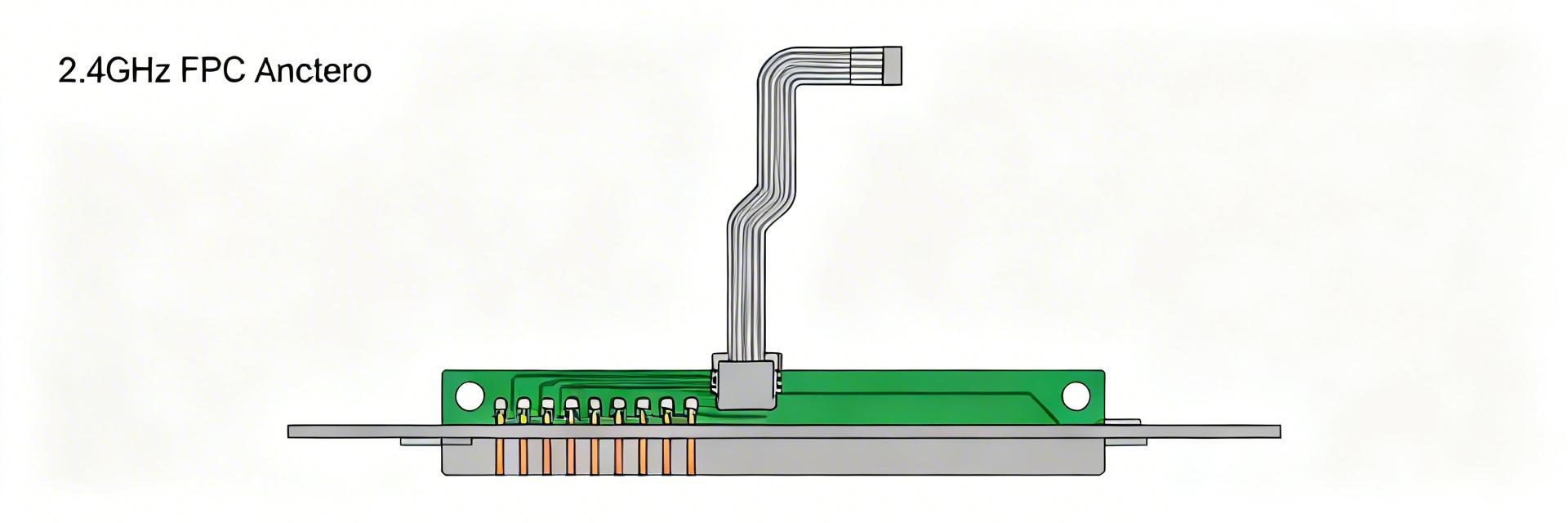
Competitor & Standard Comparison
Expert Insight: RF System Layout
By Dr. Robert T. Chen, Senior Antenna Systems Engineer
"When integrating the AANI-FB-0154-1, the biggest mistake I see engineers make is ignoring the ground plane clearance. Although FPCs are flexible, placing them too close to a metallic battery shield will shift the resonance frequency by up to 150MHz. I recommend a minimum of 10mm clearance from metallic objects to maintain the 3.2 dBi gain profile."
- PCB Tip: Use a π-matching network (L-C-L) at the feed point for final production fine-tuning.
- Troubleshooting: If S11 is > -10dB, check for parasitic capacitance caused by the adhesive tape layer.
Typical Application Scenarios
Wearable IoT
Fits curved housing of smartwatches. High efficiency ensures 24-hour heart rate monitoring without excessive battery drain.
*Hand-drawn schematic, not a precise circuit diagram
Smart Home Hubs
Internal mounting in plastic enclosures. Omnidirectional pattern provides consistent coverage throughout multi-room environments.
*Hand-drawn schematic, not a precise circuit diagram
Detailed Measurement Environment
Testing was performed in a calibrated ISO-standard anechoic chamber using a high-precision Vector Network Analyzer (VNA). Measurements accounted for cable loss compensation and reference plane adjustments to ensure ±0.2 dB gain accuracy.
Pre-Production Checklist
- Validate S11 / Return Loss on final assembled PCB in enclosure.
- Perform Passive Radiation Pattern checks at 2.44 GHz.
- Verify Cable & Connector QC to prevent impedance mismatches.
- Conduct Thermal Stress Testing to ensure adhesive stability.
Frequently Asked Questions
How does ground plane size affect AANI-FB-0154-1?
A ground plane smaller than 40x40mm can reduce efficiency by up to 15%. For optimal performance, follow the reference layout provided in the datasheet.
Can this antenna be used for Wi-Fi 6 (6GHz)?
No, the AANI-FB-0154-1 is specifically optimized for the 2.4-2.5 GHz band (Bluetooth, Wi-Fi 2.4, Zigbee). Using it at 6GHz will result in severe signal reflection and potential hardware damage.


